Biometric Smart Cards in India 2027: How Fingerprint-on-Card Works and Where It’s Heading
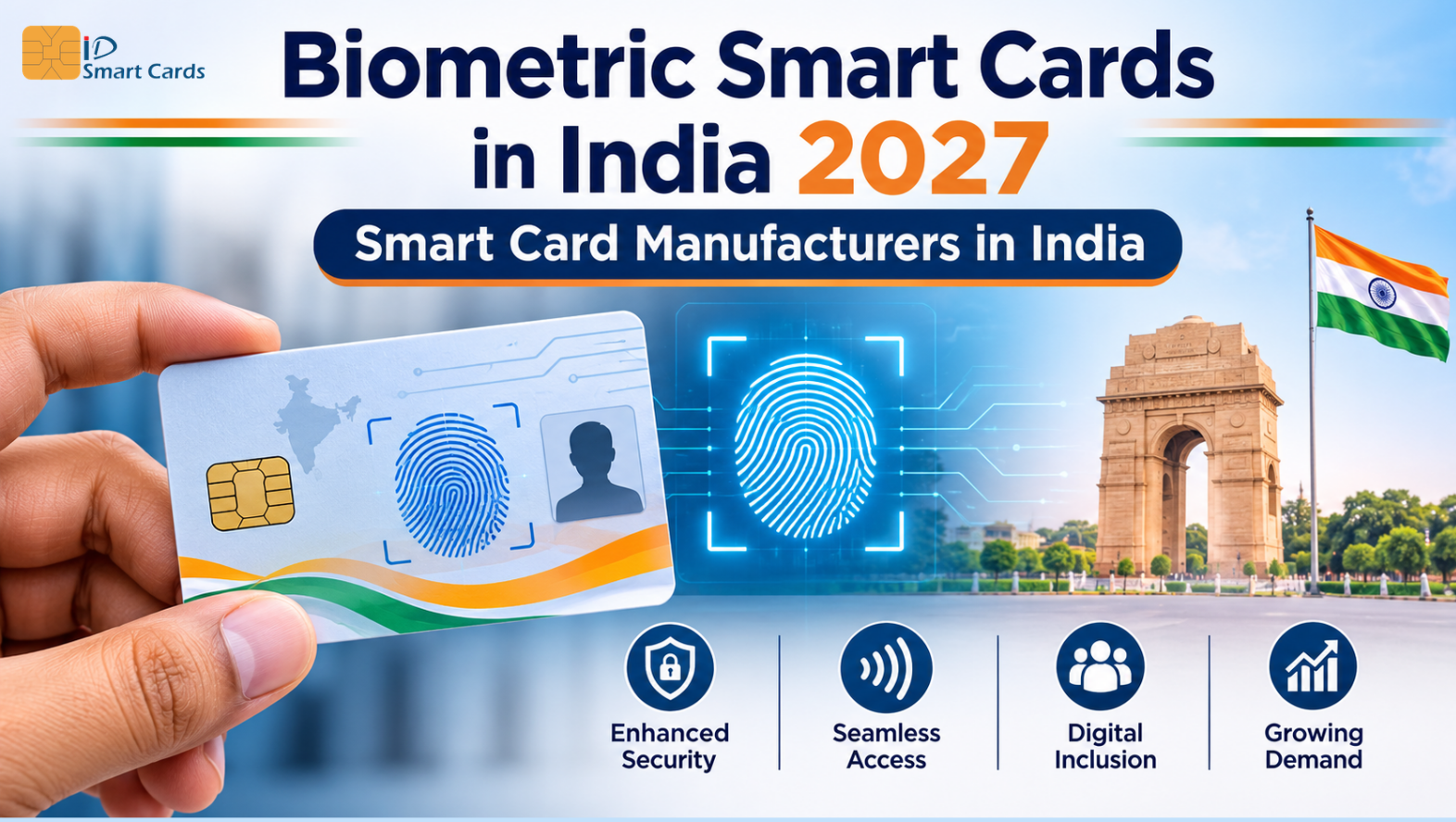
Every year India issues the equivalent of billions of rupees worth of digital transactions, millions of identity cards, and an ever-increasing number of access credentials. Underpinning each of those is the simple question of whether the person in possession of that card is actually the person it was issued to. A PIN can be passed on, a signature can be faked, and a plain old RFID card can be loaned to a friend. Biometric smart card manufacturers in India close that gap by having your fingerprint (and the proof of it) inside the card.
This guide explains fingerprint-on-card technology in plain English. It explains how it works, where it’s already making sense in India, what’s likely to be the case by 2027, and what you should be looking for when you’re evaluating smart card manufacturers in India for a biometric or secure identity project.
What is a biometric smart card?
A biometric smart card is a smart card that authenticates the user via a physical characteristic (most commonly a fingerprint) rather than just something the user knows (a PIN) or something the user has (the card itself). There’s a small fingerprint sensor embedded in the card body. The user simply places a finger on the sensor, and the card makes the determination as to whether the finger matches the one that was originally registered.
The key point is where the decision is made. In a properly designed fingerprint-on-card system, the fingerprint template never leaves the card. It’s not sent to the reader, it’s not sent to a server, and it’s not sent to the cloud at all. The card simply tells the reader, “The right person is present,” and the transaction or access request can proceed as normal.
That’s the ‘match on card’ design, and that’s precisely why biometric smart cards are regarded as both secure and privacy-friendly in comparison to systems that store the fingerprint in a central database.
How Fingerprint-on-Card Works, Step by Step
The process has three stages: enrollment, storage, and verification.
STEP 1. Enrollment, Registering the fingerprint:
When the card is issued, the cardholder places a finger on the embedded sensor (usually quite a few times from different angles). The card processor takes each of those scans and converts it into a mathematical template (a set of data points describing the ridges, loops, and so on). It’s not a picture of the fingerprint at all. All of those individual templates are then combined into a single reference template.
Enrollment is normally carried out once at an issuance counter, a bank branch, an enrollment camp, or via a secure personalization process arranged by the issuer.
STEP 2. Storage: locking the template inside the chip:
The reference template is stored within the card’s secure element (a tamper-resistant chip designed to protect the keys and sensitive data). The secure element is designed to be resistant to physical probing, side-channel attacks, and attempts to read its memory. The template is encrypted and is never exported.
STEP 3. Verification: matching on the card:
Each time the card is used, the process looks like this:
- The cardholder touches the sensor.
- The sensor takes a new scan, and the card’s processor generates a new template from it.
- The processor compares the new template against the stored reference entirely within the card.
- If the match score exceeds the set threshold, the card activates its secure functions, and the transaction, door opening, or login can go ahead.
- If the match fails, the card remains locked. After a certain number of failed attempts, many designs will then fall back to a PIN or block the card.
As the comparison takes place locally, there’s no biometric database for an attacker to compromise, and nothing sensitive travels over the air between the card and reader.
What’s inside a fingerprint smart card?
A biometric card looks like an ordinary card but contains several extra components:
Fingerprint sensor:
A thin capacitive sensor that reads the ridge pattern. Capacitive sensors are preferred for cards as they’re thin, robust and very difficult to fool with a simple copy.
Secure element and processor:
The chip that holds the template runs the matching algorithm and houses the cryptographic keys.
Antenna and inlay:
A contactless smart card requires a precisely engineered antenna layer (the inlay) so that it can communicate with readers via NFC or RFID. Dual interface inlays are also capable of enabling contact chip communication.
Power source:
The majority of fingerprint cards have no battery at all. They derive their power from the reader’s field or from the contact chip pads (which is why they’re so thin and flexible). A few designs do incorporate a very thin battery for particular applications.
Card body:
Laminated PVC or other durable material (often with security printing, holograms and optional personalisation).
The inlay is where card quality is generally determined. A poor antenna will result in poor read range and failed taps regardless of the quality of the sensor. That’s why the manufacturer you choose is so important.
Biometric Cards vs PIN Cards vs Standard RFID Cards:
| Feature |
Standard RFID card |
PIN-protected smart card |
Biometric smart card |
| Proof of identity | None (anyone holding it can use it) | Something you know | Something you are |
| Risk if lost or stolen | High | Medium (PIN can be guessed or shoulder-surfed) | Low (fingerprint required) |
| Can it be shared or lent? | Yes | Yes, with the PIN | Very difficult |
| Speed at the reader | Fast | Slower (typing a PIN) | Fast (one touch) |
| Data stored centrally | Often | Often | No, in match-on-card designs |
| Typical cost | Lowest | Moderate | Highest, but falling |
Where Biometric Smart Cards Fit in India:
India is the perfect market for this technology. It has a massive base of contactless smart card acceptance, a very well-developed digital identity, a huge number of government benefit schemes, and a real drive towards secure and inclusive payments. That’s where fingerprint-on-card really comes into its own.
Banking, Payments, and Fintech:
Banks and card networks have been trialling biometric payment cards (using a fingerprint instead of a PIN) for higher-value contactless smart cards payments all over the world. For India, the case is particularly strong in that you eliminate the need to remember or enter a PIN and you reduce fraud if the card goes missing. The obvious early adopters will be prepaid cards, corporate cards, and wallet-linked cards.
E-governance and benefit cards:
India already has a host of card-based schemes in place (SCOSTA cards, compliant driving license and registration cards, health insurance cards under Ayushman Bharat, etc.). The addition of biometrics ensures that the benefit goes to the actual cardholder and not to someone else who may be in possession of the card.
Healthcare:
Hospitals use smart cards for patient ID, for access to records, and for insurance verification. The card is fingerprint-protected so that the patient’s records are only released to the patient or to authorized staff.
Public transport and mobility:
Closed-loop and open-loop transit cards (mobility cards) are being rolled out across Indian cities. Biometric cards won’t be used for every tap but can be used to secure high value or concession cards (e.g. senior citizen, student, or employee) against misuse.
Enterprise, campus, and high-security access:
Data centres, defence facilities, labs, banks, and pharma plants all often have a requirement for multi-factor access. A card that can prove “card plus person” in one touch is far more convenient than a card plus a separate biometric reader at every door.
Border security and travel documents:
E-passport inlays already contain a chip with the holder’s data and photo. As travel documents continue to develop, secure chips and biometric verification will remain at the heart of border control, and that’s why chip and inlay quality is so important.
Where Biometric Smart Cards Are Heading in India by 2027
No one can predict the market with any degree of certainty, but there are a number of trends which all point in the same direction.
1. Falling costs:
Fingerprint sensors and secure chips are getting smaller, cheaper, and more power-efficient. As volumes increase, the cost differential between biometric and conventional smart cards will close, making the pilot’s case much easier to make.
2. Wider adoption of contactless and NFC:
With contactless smart cards and NFC readers now the norm, biometric cards can be introduced without requiring merchants to go out and buy new hardware.
3. Government-led digital identity:
India’s continued focus on digital public infrastructure to strengthen demand for secure credentials is liquidating the use of chip-based identity and benefit cards.
4. Privacy-first design:
With the Digital Personal Data Protection Act 2023 dictating how personal data is to be handled, Match on Card is appealing, as the biometric data remains with the individual rather than in a central database.
5. Stronger standards and certification:
Issuers are increasingly demanding compliance with recognised standards such as ISO/IEC 7816, ISO/IEC 14443 and the relevant EMVCo and network requirements for payments.
6. Sustainable materials:
Alongside security, buyers are looking at recycled PVC, bio-based, and wooden cards. You can expect the biometrics space to follow a similar trend.
7. Convergence with mobile:
Digital wallets and phone-based credentials will grow, but physical cards will still be the essential option for people without a smartphone, for use in an offline environment, and as a fallback.
8. Growth of local manufacturing:
The Make in India push is encouraging issuers to source their cards, inlays, and personalization from local suppliers, with the benefits of shorter lead times and easier support.
Challenges to Plan For Biometric smart cards:
Biometric smart cards are very powerful. A successful deployment, however, requires a very realistic plan.
- Cost: The unit price is higher than a standard card, so you’d want to start with use cases where the security benefit is clearly going to outweigh the cost.
- Enrolment logistics: Capturing quality fingerprints at scale requires trained staff and good processes. Worn fingerprints (e.g. from manual labourers or the elderly) may require a number of attempts or a fallback method.
- Environment: Dust, moisture and extreme temperatures can all have an effect on sensor performance. Test in real-world conditions.
- Standards and certification: Ensure the card, chip and sensor all meet the standards your programme demands.
- Fallbacks: Always define what happens when a finger can’t be read (e.g. a PIN or supervised verification).
- Data protection: Document how the templates are created, stored and protected so that you can demonstrate compliance.
Why Choose ID Smart Card Manufacturers Among Smart Card Manufacturers in India
If you’re looking at smart card manufacturers in India for a secure identity, payment or access project the depth of the manufacturer is as important as the card specification itself. Here’s why organisations go for ID Smart Cards.
A full range of smart card products under one roof:
ID smart card manufacturers work across plastic cards, contactless smart cards, contact chip cards, dual interface cards, contactless card inlays, dual interface inlays and electronic passport inlays. Biometric cards are all built on these same components, so working with a manufacturer who already produces them minimises the number of handoffs between suppliers.
Experience across sectors that demand security:
The company serves a number of sectors including border security, mobility, secured identity, health, e-governance and fintech. That’s the same set of sectors where the biometric smart card is expected to grow, so they’re very much in the know in terms of the compliance, the volume and the reliability requirements of large-scale programmes.
Proven work on Indian card programmes:
From SCOSTA cards through to health cards for schemes like Ayushman Bharat and RSBY, ID Smart Cards has the experience of working with the standards-driven, high-volume cards that the Indian government and its institutions require.
Technology breadth: RFID, NFC, MIFARE and DESFire:
Whatever your project requires in terms of security (MIFARE or DESFire), NFC for mobile interaction or a dual interface solution that will work with both contact and contactless readers, the team can advise you on the correct chip and inlay combination to achieve your objective rather than just sell you one particular product.
Customisation and sustainability options:
Things like loyalty cards, hotel key cards, NFC wearables and even wooden RFID key cards indicate a manufacturer who is quite happy to produce custom designs using eco-friendly materials. That’s a big plus if you’re after a branded, sustainable biometric-ready card.
Indian support and a global outlook:
Working with an Indian manufacturer gives you local technical support, much faster communication and easier coordination on samples, pilots and delivery. The company is also well established in terms of international standards.
Ready to look at a biometric or secure card project?
Just drop us a note with your requirements, volumes and use case, and the ID Smart Cards team will be in a position to recommend the right card type, chip, inlay and personalisation.
Talk to a Leading Smart Card Manufacturer in India
Ready to put together a biometric, contactless, or dual-interface smart card project? ID smart card manufacturers can help you select the right card, chip, inlay and personalisation for your application, whether that’s a small pilot or a major scale-up.
To get a fast, accurate quote, share these details with our team:
- Your use case (payments, identity, access control, health, transit or loyalty)
- The card type you have in mind (contactless, contact, dual interface or biometric)
- Estimated order volume and delivery timeline
- Any standards or compliance requirements, contact to request samples, a custom quote or to arrange a free consultation with one of the established smart card manufacturers in India. The trusted smart card manufacturers in India.