Loyalty Card Manufacturers in India: The Shift Toward Hybrid Loyalty Programs in Retail in 2027
Indian retail has a loyalty problem that is really nothing to do with discounts. People have loads of loyalty cards, app logins and wallet passes, yet they’ll invariably leave the card at home, ignore the app or just stop using both after a few purchases.
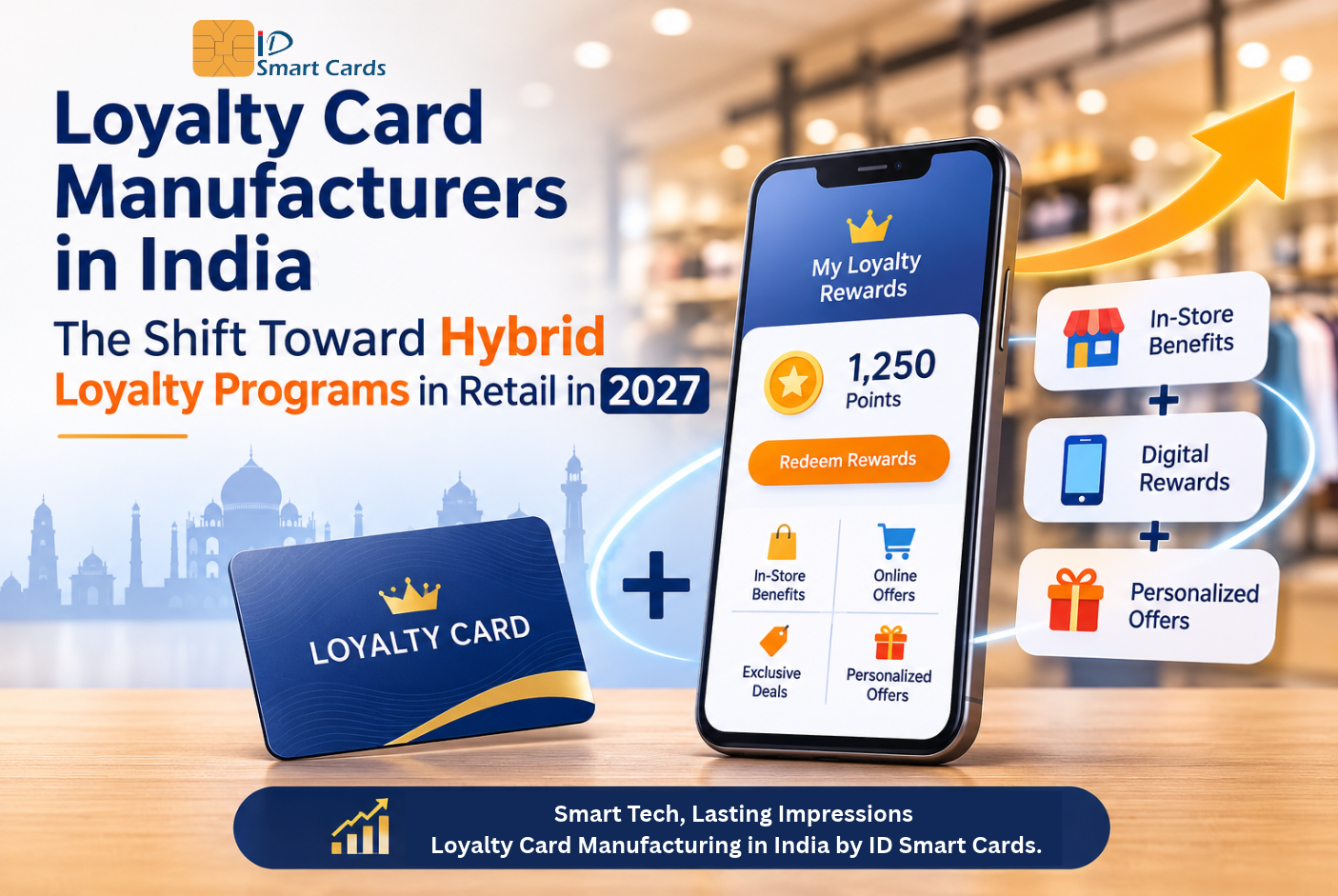
That’s why so many retailers are now moving to hybrid loyalty programmes. Rather than force the customer to pick between a physical card and an app, the hybrid model allows them to use both. The card is the reliable in-store touchpoint, and the digital side is where the rewards, offers and tracking happen.
For brands looking at making the move, the choice of loyalty card manufacturers in India is far more important than it used to be. The card is now the gateway into the wider system rather than simply a piece of plastic.
What is a hybrid loyalty programme?
A hybrid loyalty programme links a physical loyalty card to the digital systems so that customers can earn and redeem rewards across multiple channels. A typical arrangement would be:
- A smart physical card with an RFID chip (RFID loyalty cards), an NFC chip (NFC loyalty cards), a barcode or a QR code
- A mobile app or web portal where customers check points, tiers and offers
- Digital wallet or phone-number-based access as a backup when the card isn’t with them
- A central database that unifies purchases across stores and channels
The customer can tap a card at the counter, scan a QR code or give a mobile number. All three of those options feed into the same account.
Why Retailers Are Moving to Hybrid Loyalty in 2027
1. Customers want choice, not yet another app.
App fatigue is very real. People won’t go down and download a separate app for every store. They’ll quite happily tap a card they already have in their wallet. Hybrid is the way to go in that respect.
2. Physical cards still build habit and brand recall.
A well-designed card is in their wallet and reminds them of your brand every time they open it. A disregarded app icon doesn’t.
3. Billing counters need speed.
Tap-based RFID and NFC cards identify the customer in a second. That’s obviously important in a high-volume environment like a supermarket, pharmacy, salon, restaurant or fashion retailer where long queues are a real experience killer.
4. Better data leads to better personalisation.
When every transaction is linked to a customer profile, you can see purchase frequency, average basket value and preferred categories. You can then run targeted offers rather than generic discounts.
5. Expectations concerning data privacy are on the rise.
With the DPDPA in place, retailers need to be very careful about how they collect and use customer data. A structured loyalty programme with express consent is far easier to manage than a collection of disparate manual records.
Card Technologies Compared
The correct technology will be down to your retail format, your budget and how much of a digital layer you’re going to build.
| Card Type | Best For |
Strengths / Limitations |
| Barcode / QR cards | Small retail, quick launch | Low cost and works with most POS software, but easily copied and has no security features |
| Magnetic stripe cards | Legacy systems | It is familiar and inexpensive, but it wears out and is less secure. |
| RFID cards (13.56 MHz) | Supermarkets, pharmacies, salons, chains | Fast tap, durable, secure IDs, but needs compatible readers |
| NFC cards | Hybrid programmes, phone-linked rewards | Works with readers and NFC phones and can open a loyalty page or app, at a slightly higher cost than a barcode |
| Hybrid cards (RFID/NFC + barcode/QR) | Multi-outlet and omnichannel retail | One card works across old and new systems but needs planning at the design stage. |
For the vast majority of retailers moving into the hybrid loyalty space, the sensible route is to go with NFC or RFID cards that have a printed barcode or QR code on them. They work with both the new digital layer and the existing billing systems.
What to Look for in a Loyalty Card Manufacturer in India
Not every card printer can support a hybrid program. Once you know the technology you need, check these points before you shortlist a manufacturer:
- Chip and technology range. Can they provide RFID, NFC, barcode and QR options as well as combinations?
- Personalisation capability (variable data printing), sequential numbering, barcodes and QR codes are all essential for a loyalty programme.
- Print and finish quality: colours should be consistent across batches, and the card should be reasonably scratch resistant.
- Materials available are predominantly standard PVC loyalty cards, although some brands are now asking for recycled or green materials.
- Data security and handling. Your customer and card data must be handled in a confidential manner at all times during the personalisation process.
- Integration awareness. The manufacturer should have a good understanding of how the cards work with POS and CRM software and should be able to assist you in choosing the correct chip and format.
- Bulk capacity and delivery times. That’s important when you’re rolling out across a number of outlets.
- Sampling and testing. A reputable manufacturer will provide you with samples so you can test the cards with your readers prior to placing a large order.
How a Retailer Can Set Up a Hybrid Loyalty Program
-
Define the goal:
Are you after repeat purchases? Higher basket value? Referrals? Data capture?
-
Choose your reward model:
Need to choose the correct reward model, like points, tiers, cashback, stamp-based or a combination of the above.
-
Select the card technology:
You’ll need to pick either RFID or NFC depending on your readers and your digital plans.
-
Decide on the digital layer.
An app, a web portal, wallet passes or mobile number lookup.
-
Design the card.
Make it something the customer is truly happy to keep, with clear branding and a simple benefit message. It includes the logo, picture, store image and so on.
-
Order some samples and do the testing.
Check the readability on your actual POS hardware and on your actual phones.
-
Pilot programme:
Need to run the pilot programme in a few outlets, train the staff, get the feedback and fix the issues before you scale.
-
Roll it out and promote it:
Give the customer a reason to sign up at the counter (e.g., a joining bonus).
Why Choose ID Smart Cards as Your Loyalty Card Manufacturer
If you’re looking at a hybrid loyalty programme, then ID Smart Card Manufacturers can help you get the physical layer sorted from the outset.
- Wide card options available. RFID, NFC, barcode, QR and combination cards to fulfil various retail requirements.
- Custom designs. Cards that match your brand, full colour printing and finish options available.
- Variable data personalisation – unique numbers, barcodes and QR codes for each card.
- Bulk order support. Appropriate for single-store pilots right up to multi-outlet retail chains.
- Guidance on chip selection. Help in the choice of the right technology for your readers and your software.
- Sample first approach. Test the cards in your own environment prior to committing to a large order.
Planning a loyalty programme for your retail business?
Speak to the ID Smart Cards manufacturers team about their RFID and NFC loyalty cards, which are specifically designed for hybrid programmes. Let us know your quantity, card type and design requirements, and we’ll help you pick the right one.