Boosting Hospital Efficiency: How RFID Smart Card Manufacturers Are Revolutionizing Healthcare Tracking
Modern healthcare is fast. In the ICU, in the outpatients, in the pharmacy you’re under constant pressure to get things right. You’ve got to protect data and you’ve got to secure the restricted areas. The pharmacy and other areas are under constant pressure. You have to get the workflows right, protect the data and secure the restricted areas. The old ways don’t work anymore. Manual tracking, paper logbooks, magnetic stripe keys etc are all things of the past.
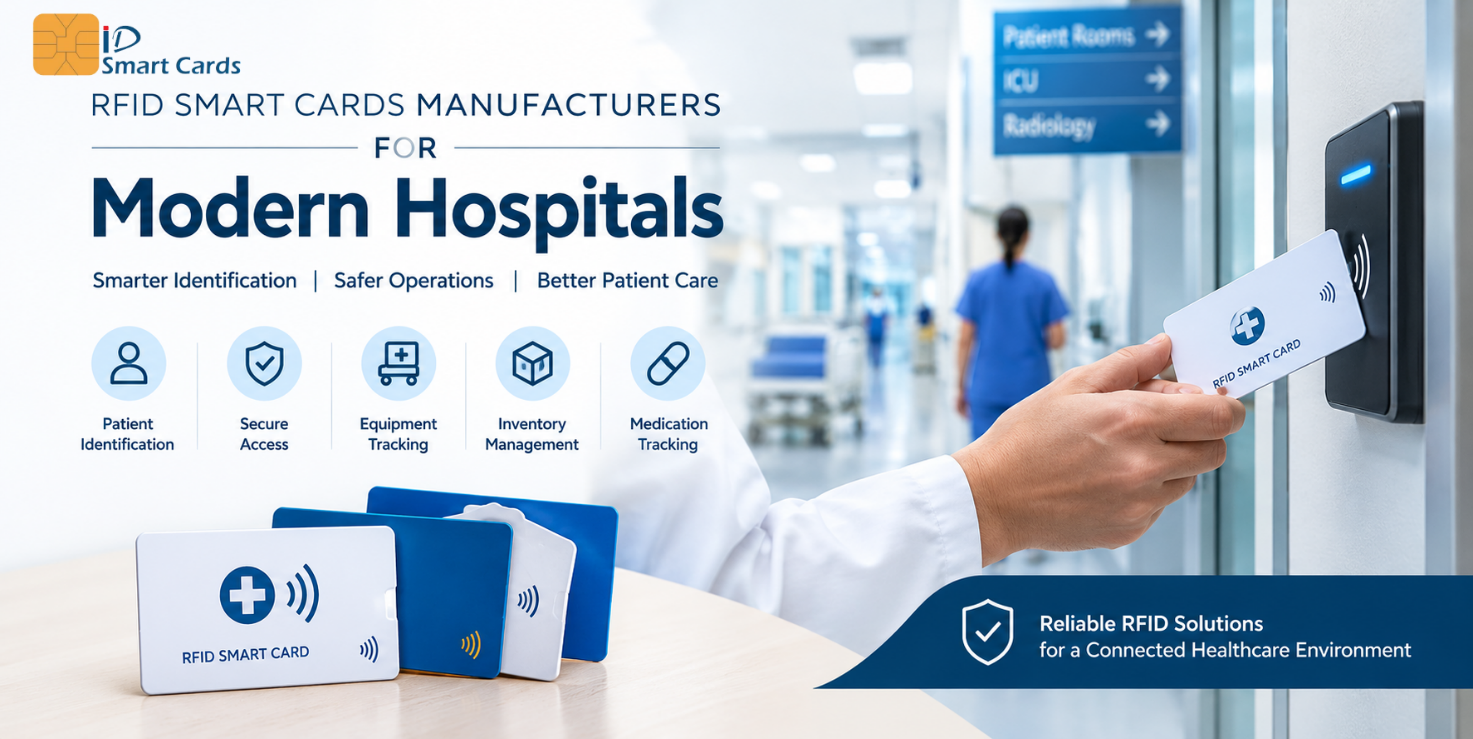
To deal with these issues, the major medical centres around the world are now utilising rfid smart cards manufacturers. ID smart card manufacturers can produce robust, custom RFID smart cards which can do a whole host of things. You can use the card to control access, track people and equipment in real time and enhance patient safety all on one card.
The Operational Difficulties in Traditional Healthcare Facilities
Before we get on to the impact of RFID access cards in healthcare it’s worth bearing in mind the key problems that hospitals are currently facing.
- Slow patient check-ins and huge admin backlogs: Patients can be delayed in their treatment as a result of the long queues at the front desk and this creates a very stressful environment for everyone.
- Asset and equipment misplacement: Staff spend a huge amount of time looking for their key mobile medical equipment (infusion pumps, portable monitors, wheelchairs etc).
- Contamination: Risk of cross contamination via shared clipboards, sign in sheets and multi-key lockers in clinical areas.
Key Differences of Traditional vs RFID-Enabled Healthcare Facilities
| Feature / Operational Area | Traditional Healthcare Facilities | Modern RFID-Enabled Facilities |
| Patient Identification | Uses ID cards, wristbands, or manual checks | Uses RFID-enabled wristbands for faster identification |
| Patient Tracking | Staff manually check patient locations | RFID helps staff locate and track patients in real time |
| Medical Equipment Tracking | Staff search for equipment manually | RFID tags help locate and track medical equipment |
| Inventory Management | Stock is checked manually | RFID helps monitor stock levels and item movement |
| Medication Management | Staff scan barcodes or check labels manually | RFID can help identify and track tagged medication items |
| Access Control | Uses keys, access cards, or manual verification | RFID cards allow contactless access to restricted areas |
| Data Collection | Staff enter information manually | RFID readers can automatically capture tag data |
| Error Reduction | Depends heavily on manual processes | Automation can reduce certain identification and tracking errors |
| Time Efficiency | Some tasks require more staff time | Automated tracking can speed up routine tasks |
| Asset Security | Relies on manual checks and security procedures | RFID monitoring can help identify missing or misplaced tagged assets |
| Record Accuracy | Depends on timely and accurate manual entry | Automatic data capture can improve tracking records when systems are configured correctly |
| Operational Visibility | Information may be spread across different records | Integrated RFID systems can provide more timely operational information |
How RFID Smart Cards and Tags Improve Hospital Efficiency
An RFID smart cards manufacturer link physical security to the digital data systems via wireless communication. It has a microchip and an internal antenna which enables it to transmit its unique ID number to a reader instantly and contactless.
RFID Contactless smart cards enable you to gain access to secure areas simply by tapping or holding the card up to a reader.
1. Streamlining access control in high-security medical areas.
RFID access cards are used to gain access to high security areas (operating theatres, ICUs, radiology, lab cleanrooms etc). They provide a high level of security in that they have a unique ID number which is very difficult to clone and thus provide a high level of security and protect the confidentiality of patient records.
However, RFID Contactless smart cards system can be cloned. To mitigate that risk administrators should be using advanced multi-layer cryptographic encoding.
Regularly update access permissions and security settings. Work with the manufacturer to install security updates and promptly deactivate any lost or stolen cards. Train staff in the safe handling of cards and carry out regular security checks. All of these things will help to ensure that only the appropriate people are able to enter the restricted hospital areas.
2. Patient tracking & RFID smart wristbands
Patient safety from admission right through to discharge is all about accurate identification. RFID smart wristbands and cards provide the patient with a digital identity throughout their stay.
1. Real-time patient safety monitoring with UHF RFID wristbands:
Keep track of where patients are in memory care and children’s units, so staff can quickly help if someone is about to wander off. If a patient goes somewhere, they shouldn’t, the system sends an instant alert.
2. Error-free medication and care delivery:
Before administering any medication or carrying out any procedure the clinical team will scan the patient’s RFID wristband. They’ll check the patient’s EHRs to confirm identity, dose and allergies. This is to avoid serious errors.
3. Rapid admission and flow optimisation:
RFID smart access cards speed up check-in and automatically update the queue system. They help to ensure a smooth flow from the ER through to radiology and onto the operating theatre.
3. Medical asset and equipment tracking System:
Nurses and hospital staff spend a lot of time searching for medical equipment around the hospital. RFID tags and readers make it a lot easier to find and manage the equipment.
1. Instant equipment location:
Fixed RFID readers in the corridors and at the doors track the valuable medical equipment. This includes infusion pumps, ventilators, defibrillators, wheelchairs and ECG machines. Their location is then visible on a central hospital map.
2. Automated Preventive Maintenance:
The system will automatically log equipment usage and movement and then schedule the associated calibrations, cleanings and safety checks at the appropriate time to prevent failure. Staff are automatically alerted the moment a tagged medical device passes within a certain distance of an unauthorised exit point which in turn greatly reduces the incidence of equipment loss and the cost of replacement.
4. Pharmacy Inventory & Controlled Substance Tracking
Managing medicines and controlled drugs is vital to the running of the hospital and to the purchasing process. RFID tracking is a useful tool in terms of monitoring stock, managing the distribution of drugs and checking the records.
1. Automated stock counts and expiry management:
RFID smart labels on the medication boxes, the trays and the unit dose packs. The pharmacy can do its stock audits in seconds with absolutely no manual scanning required at all. Items approaching expiry are automatically flagged which in turn reduces drug waste.
2. Secured controlled substance dispensaries:
- Secure entry: authorised staff can use RFID smart cards to unlock the automated medication cabinets.
- Automated audit logs: every interaction is logged, creating a real time digital log of who accessed what drug and when.
3. Cold chain and environmental integrity:
- What they do: RFID sensors are used to monitor the temperature of vaccines and medicines during storage and transport.
- Why it matters: if a fridge or cold store unit fails, they immediately alert the pharmacy manager to prevent any product from going off.
5. Bringing All Your Hospital Systems Together
- The challenge is that hospitals use a variety of systems (patient records, security cameras, alarms etc) which don’t work well together.
- The solution is modern RFID smart cards which will bridge the gap and provide a much more seamless connection between the various systems in the hospital.
- Key Benefits: They instantly share real-time data across every platform, including:
- Access: Who is coming and going.
- Tracking: being able to find patients and equipment quickly.
- Safety: triggers instant security alerts.
The Future of Healthcare Tracking:
1. Growing Importance:
As healthcare moves into the smart building space, RFID smart cards are going to be absolutely essential. The technology will bring with it a raft of new innovations.
2. Multi-factor biometric integration:
RFID smart cards (along with fingerprint or face recognition) make access to places like medicine stores and research labs a lot more secure.
3. Mobile wallet synergy:
The physical smart cards will work in conjunction with the virtual employee badge on your smartphone (for greater convenience).
4. Enhanced on-card encryption:
Advanced encryption to ensure complete data privacy and compliance with international healthcare standards (HIPAA, NABH).
Practical Steps for Administrators to Prepare for Smart Building Integration:
Step 1. Audit your current operations:
To see where things are slowing down. This could be in areas where staff find it difficult to get in, or where equipment is difficult to locate. RFID smart cards or smart building solutions can help to speed those processes up and make them much easier.
Step 2. Ensure System Compatibility:
Talk to your RFID provider and IT team before adding new technology. This way, you can be sure everything will work well with the equipment and systems your hospital already has.
Step 3. Roll Out in Phases:
Begin upgrades in the most important areas first—like places that keep patients safe or where staff need quick access. This way, the hospital can keep running smoothly while you make improvements.
Step 4. Train & Support Staff:
Help your team feel confident by offering simple, hands-on training. Show them how these smart tools make daily work easier and help them take even better care of patients.
Step 5. Partner for the Long Term:
Choose a trustworthy tech partner who will give your ongoing support, keep your systems secure, and help you stay up to date.
ID smart card experts say that as hospitals become more connected, RFID smart cards manufacturers will be the primary means of identifying people. These cards will be used for everything (access to buildings, equipment tracking and logging in to mobile devices). One card for all these purposes will mean the hospital can run more smoothly and safely for everyone.
Why choose a specialist ID smart card manufacturer?
Deploying a hospital-wide RFID smart cards tracking infrastructure requires good quality, reliable hardware. By going direct to an experienced ID smart card manufacturer, you get a number of advantages over a generic 3rd-party vendor:
1. Medical-grade durability and hygiene:
The RFID smart cards manufacturers make these cards from strong, water-resistant plastic that also helps prevent germs from spreading. They’re designed to handle lots of cleaning and the demands of a busy hospital.
2. Custom Multi-Chip Encoding:
Allows dual frequency on a single card so that you can have door access, workstation logins, parking gates and cafeteria payments all on one card.
3. Anti-counterfeiting visual security:
These cards have clear photos and special security features that make it hard for anyone to pretend to be someone else in secure hospital areas.
4. Scalability and direct wholesale pricing:
As hospitals get bigger, they need a supplier who can quickly provide lots of cards, make sure each one is high quality, and keep costs low.
Good healthcare means looking after people and keeping them safe. When hospitals use modern ID smart cards instead of old systems, daily work gets easier for staff and patients. These cards cut down on paperwork, so care teams have more time for people. Safety is simpler, and everyone benefits. Upgrading is more than new tech it’s a way to keep the focus on people.