
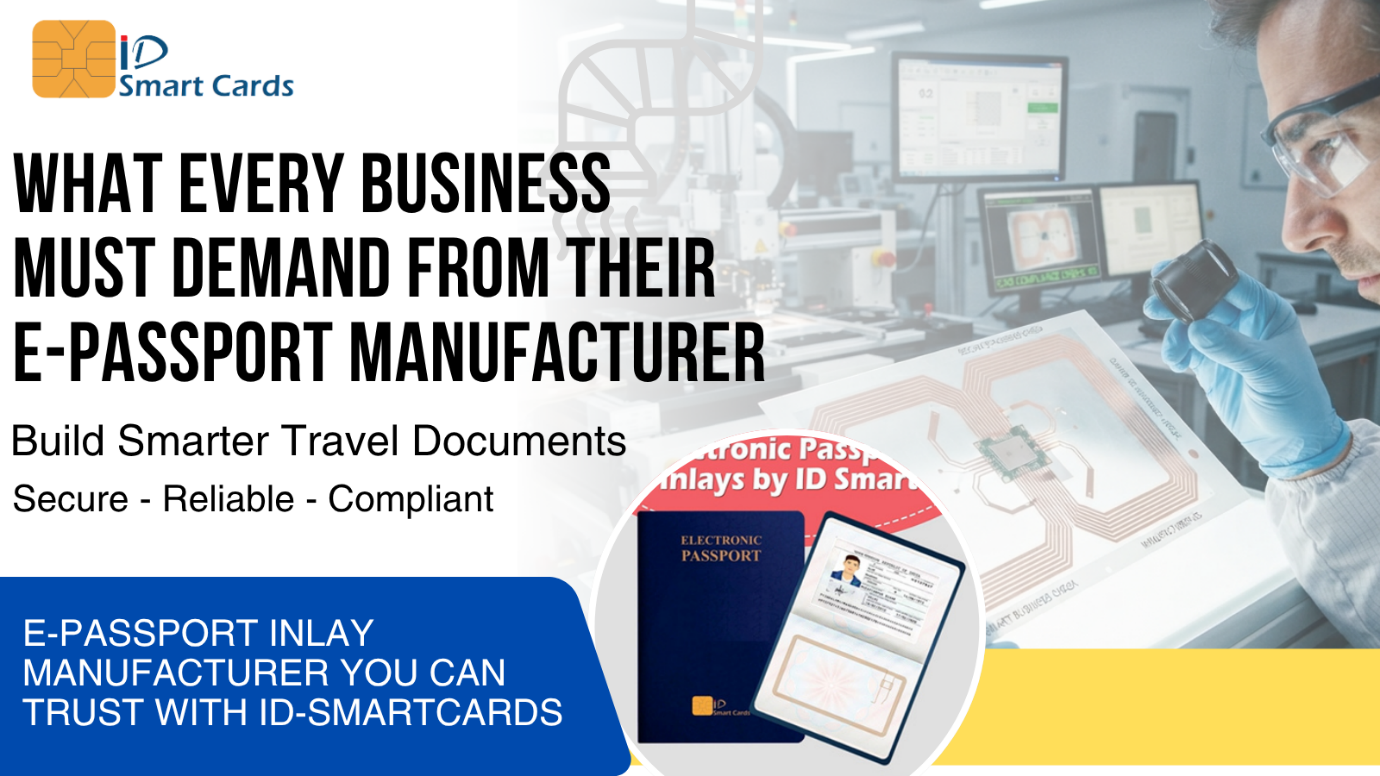
Choosing an e-passport inlay manufacturer is not a decision business should make based on price alone. This means that an e-passport inlay is an important component for businesses and organizations involved in producing or managing electronic passports under the following conditions.
Ready to partner with a trusted e-passport inlay manufacturer?
An e-passport inlay is a small electronic component placed inside an e-passport. It usually contains a chip and antenna that allow the passport to communicate wirelessly with a compatible reader.
The chip stores electronic information, while the antenna helps transmit the data. Together, they support secure and contactless passport verification.
At its core, an inlay generally contains a contactless chip and antenna integrated into a suitable substrate or structure. When the passport is presented to a compatible reader, the inlay enables wireless communication with the reader.
This technology is an important part of modern electronic identification.
What Components Are Found in an E-Passport Inlay?
The exact construction can vary depending on the application, but an e-passport inlay can involve:
1. Contactless Chip: The chip provides the electronic functionality required by the passport system.
2. Antenna: The antenna enables contactless communication between the chip and a reader.
3. Inlay Substrate: The substrate provides the physical structure on which the electronic components are integrated.
4. Protective layers: Help protect the electronic components during handling and use.
Imagine ordering a large batch of inlays for a production project.
Now you have to deal with:
A small saving on the purchase order can quickly become a much larger business cost.
That is why experienced procurement teams look at the total value of a supplier, not simply the unit price.
A reliable manufacturer should be able to demonstrate:
The first thing to investigate is the manufacturer’s actual technical experience. E-passport inlays aren’t standard printed labels or generic RFID tags.
A capable manufacturer should understand areas such as:
Before requesting a quotation, ask:
Use these questions to tell the difference between a true manufacturing expert and an RFID reseller.
Ready to discuss how id smart cards technical stack up against industry standards?
The chip handles the data, and the antenna allows contactless communication with card readers. Both are important for the e-passport inlay to work properly.
The two components must work together effectively.
Proper integration of the chip into the inlay is essential for the intended application and technical specs.
The antenna design must match the document’s build and communication requirements.
The chip-and-antenna link needs to remain durable during production and over the years the document is used.
The complete structure should be suitable for integration into the passport or e-cover.
Instead of asking only:
“How much does one inlay cost?”
A more useful question is:
“How do you ensure consistent chip and antenna performance across every production batch?”
Quality control should be one of the first topics discussed with an e-passport inlay manufacturer.
A supplier should have defined processes for monitoring product quality during manufacturing.
Depending on the product and application, these may include:
The exact testing requirements will depend on the inlay design and customer specifications.
The bigger concern is not always one defective unit.
The bigger concern is inconsistency across a production batch.
A reliable manufacturer should be able to explain:
Transparency here is a positive sign.
Need to Know how id smart cards quality control standards defect-free?
There is no universal e-passport inlay specification that automatically works for every project.
Your requirements may depend on:
Before contacting manufacturers, prepare a basic technical requirement sheet.
Include:
Finding a technically capable manufacturer is only half the job.
The next question is:
Can they manufacture enough products when your business needs them?
Ask about:
Your initial requirement might be 10,000 units and more.
Every business project can have different requirements.
Depending on the manufacturer’s capabilities, customization can involve:
A technically good product is important, but supplier support matters too.
A reliable supplier should provide clear information about:
For B2B projects, communication is part of supplier reliability.
E-passport inlays must meet specific standards to support security, durability, and reliable communication. The main standards and requirements include:
ICAO Doc 9303 provides international guidelines for electronic passports.
It covers how passport information, including biometric and personal data, is stored and protected on the chip.
E-passport inlays generally use ISO/IEC 14443 for contactless communication at 13.56 MHz. This helps the passport communicate with compatible readers used for identity verification.
The inlay should also be durable enough to handle:
E-passports rely on PKI security to keep personal data safe from theft and tampering.
The specific security mechanisms depend on the passport system and its requirements.
Since passports are long-term documents, the inlay and structure must be strong enough for daily use.
The inlay should remain functional despite:
Instead of assuming that every e-passport inlay uses the same specification, ask:
“Which standards and technical requirements does this particular inlay configuration support?”
Then verify the answer against your project’s requirements.
When evaluating samples, don’t just look at the physical appearance.
Does the inlay maintain the required dimensions and construction?
Is the chip properly positioned and securely integrated?
Is the antenna manufactured consistently?
Does the inlay communicate reliably with the intended test system?
Can the construction withstand the physical conditions expected during document handling?
Do samples from different production batches demonstrate consistent characteristics?
Is your e-passport inlay quality built to survive the field?
A low price is attractive, but it should never replace technical evaluation.
Samples let your technical and quality teams test the product before mass production.
A supplier may handle a small order but struggle with a large production requirement.
The chip matters, but you also need to check the antenna, construction, and overall inlay. While the chip is vital, the entire inlay, including the antenna and construction, must be evaluated.
If your application has specific requirements, discuss them before production begins.
A supplier who disappears after taking your order can cause major business delays.
An RFID inlay designed for one application may not automatically be suitable for an e-passport.
When choosing an e-passport inlay manufacturer, you need a partner who adapts to your unique technical and business needs. ID Smart Cards specializes in smart ID solutions. We take the time to learn your needs before helping you choose the right product.
Instead of simply selecting a generic product, businesses can discuss:
Choosing an e-passport inlay manufacturer comes down to finding a reliable partner, not just the lowest price. Choose a supplier with strong quality, high manufacturing capacity, and customer support. Always test samples and discuss your technical needs before placing a large order. To explore your options, contact ID Smart Cards to discuss your project requirements.
For projects involving smart cards, RFID, and identification-related products.
Businesses don’t always need an off-the-shelf solution. Discussing requirements with the supplier allows for a potential solution.
For secure-document applications, consistent manufacturing and quality checks are essential.
Corporate procurement teams need clear communication, timely responses, technical discussions, and dependable coordination.
Yes, talking directly with the supplier helps reduce confusion.
If you’re evaluating e-passport inlays and want to discuss your requirements, contact the ID Smart Cards team directly.
When picking a manufacturer, here’s what to check in simple terms:
The goal isn’t to find the cheapest option it’s to find the manufacturer that offers the best mix of quality, capability, reliability, and value.
An e-passport inlay is a small electronic piece built into a passport. It lets the passport communicate with a reader wirelessly, just by holding it close — no swiping or inserting needed.
An inlay typically contains a chip, antenna, substrate, and other supporting components. The exact makeup depends on the manufacturer and its intended use.
The inlay communicates wirelessly with a compatible reader. The antenna picks up the signal from the reader, and the chip processes the passport’s electronic functions.
Yes, in many cases. Depending on the manufacturer, inlays can often be customized to meet specific physical and technical needs.
An e-passport inlay uses contactless RFID technology, built for secure documents like passports.
The antenna supports wireless communication between the embedded chip and a compatible reader. Its design and manufacturing quality can influence the contactless performance.
Yes. Samples let your team check the inlay’s quality and specs before committing to a large order.
It depends on their production capacity. Before placing a large order, check their capacity, lead times, and quality standards to make sure they can scale to meet your needs.
 Whats app